My memoir, Hope and Other Luxuries, tells about my attempts to cope with my daughter Elena’s anorexia nervosa. But it also tells the story of my creative life from the beginning of my writing career. I’ve decided to share those sections of my memoir that deal with creativity, writing, and publishing here on my blog.
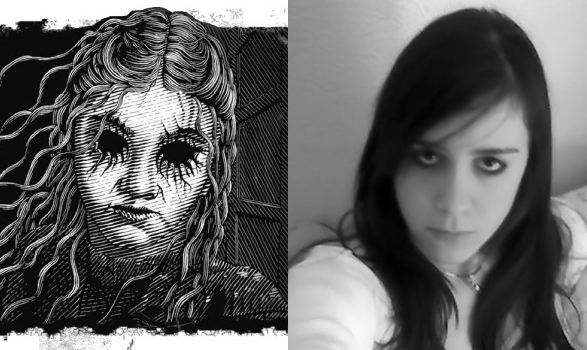
The picture above combines two images. On the left is an illustration of the ghost, Izzy, from The House of Dead Maids, the novel I wrote to mourn my runaway daughter Valerie. On the right is a photo of Valerie herself, not long before she vanished from my life. The comparison is eerie, isn’t it? But Patrick Arrasmith, the amazing illustrator, had never seen my daughter. He created his image from my descriptions in the book.
Patrick Arrasmith seems to have read my mind—because deep in the back of my mind, Izzy was Valerie. The moment when Izzy first appears was, for me, the most important moment of that writing experience. That moment was the whole reason my mind made up the story in the first place. It allowed my missing daughter to stand before me and judge me for all the things I’d done wrong in her life. It gave her a chance to warn me: We’re not so different, you and I.
But I didn’t know any of that while I was writing The House of Dead Maids. I only knew that I had to write it. Only later, when I reread what I’d written, did I realize that images of Izzy and images of Valerie were interchangeable in my mind. That’s when I finally understood.
I’ve highlighted in previous excerpts from my memoir the various ways in which my real life and my imaginary life run in parallel. The emotions of my real life bleed into my imaginary life, and my imaginary life becomes a kind of three-dimensional Jungian puzzle in which my psyche attempts to work out the problems I’m facing, such as my runaway daughter accusing me over my failures as a mother.
I’ve also highlighted some ways in which my real life and my imaginary life intersect. Distractions don’t just break my attention. They actually intrude into the “film” I’m watching and cause things to appear that don’t belong in the story. That’s because my brain, always thinking in pictures, shows me pictures of distractions, too, until the interior of my mind becomes a cluttered flea market of disconnected items.
This excerpt, which begins on page 109, brings all of these ideas together. Better than any other episode in the memoir, it illustrates the weird dance that takes place, minute by minute, between my real and imaginary worlds.
The next afternoon, I was sitting in the very same spot, curled up in one of the big, overstuffed brown chairs with my laptop open on my lap. But, although sunshine flooded the garden room with light, I was seeing another place entirely. It started between my ears, at the top of my head, and slowly grew outward, increasing in size and color until the world in front of me blurred out. Then, although I was still dimly aware of Tor twitching his paws in his sleep, that other place was all I saw.
Rough stone walls had risen out of my mind and obliterated the sunlight. I was looking down a gloomy hallway in a bleak, dismal old house, half castle and half barn. The scent of stale air rose from dank, unopened places. It made me want to hold my breath.
Shadows congregated in this dim hallway, and dust, and cobwebs, until I found myself squinting to see. As my eyes adjusted to the gloom, I could make out a figure standing in the shadows: a gray-faced girl in a ragged black dress.
This girl had been the very first of all this story’s ghosts. Her life had ended long before she came into my world. Everything that had made her human had fallen away. She had lost her fears and her joys. She had lost her eyes.
This poor little once-upon-a-time human had never shocked me, not even the very first time I saw her. But, no matter how many times I studied the empty black circles in her gray face, I never stopped feeling sad.
At the moment, I was rereading her grim story with great care, matching the image the words raised in my mind with the image the way it had looked when I had first dreamed it. If the words were wrong, they would form a fuzzy double exposure, and the image and the feelings it raised wouldn’t come into focus. But if the words were right, I could read the story just the way my readers would, and I would see exactly what I was supposed to see. Then my mind wouldn’t have to work to bring the image to life. The words would do it for me.
She stood very still in the dusky passage where the light was poorest. Like me, she wore the black dress that proclaimed her a maid of the house, but where mine was new, hers was spoiled by mildew and smears of clay. Thin hair, dripping with muddy water, fell to her shoulders in limp, stringy ropes. This was my companion of the night before—and she was dead.
I could see it all: the long, limp, wet hair and the mildew-spotted black dress. But wait a minute—was that right? Mildew was black, wasn’t it?
Could mildew be white? Or was it always black? Could mildew show up on a black dress?
Probably. Possibly. I didn’t know. And I didn’t want to wait for a copyeditor to ask. I clicked away from the Word file I was reading, pulled up Google, and typed mildew into the search box.
The phone rang: a double interruption. The eyeless ghost flickered and grew faint. I grabbed the phone with my free hand as I scrolled through the Google results, willing the ghost to stay where she was.
“Hello,” I said, scanning. This stuff was all about mildew in houses. But there, at least the Wikipedia article mentioned clothing.
“Hello, this is Dr. Petras. I have your daughter Elena here.”
Dr. Petras? Right, the child psychiatrist with the silly, droopy mustache. I had dropped Elena off at the hospital two hours ago, and she had intended to walk upstairs to her appointment after she did some volunteering. He must be calling to confirm that she wouldn’t be coming back to see him. Maybe he needed to talk about her prescription.
Did Elena still need that Zoloft? Her feelings about Valerie weren’t as raw now as they’d been a few months ago.
At the thought of Valerie, the eyeless ghost standing in front of me changed. Now my absent daughter stood in her place. Long hair, pale oval face, black eye shadow, ragged black clothes. The impression in my mind—the wistful sadness—remained the same.
But it’s getting better, I reminded her. You sent me an email just yesterday. You’re crazy about Clint, your new boyfriend, you told me. You wrote to say that you love me.
Meanwhile, in my ear, Dr. Petras had charged ahead. His voice was stern, like a reprimand from the boss. After listening for a few seconds, I realized that I wasn’t sure what he was talking about. Ghost in the room, ghost in the Word file, ghost in my family circle—I couldn’t break free from it all quickly enough for him.
“I’m sorry,” I blurted into the flow of stern words, “but what is this about?”
“Your daughter has anorexia nervosa.”
Anorexia nervosa?
What?
The shadow of the lost Valerie slipped away like a raindrop. Headlines lit up in my mind. Somewhere in there was Karen Carpenter’s strong, expressive voice, half laughing, half crying, saying she had the blues.
“Anorexia?” I heard myself say stupidly. “My daughter? You mean . . . Elena? You do mean that daughter, don’t you?”
But . . . she’s the one who’s completely normal! I thought.
A woman came walking through my memory. Her pelvic bones were sharp points under a green minidress. Her knees and elbows looked like knots, and her rough skin sagged into hollow places and dipped from neck bone to shoulders. That memory blurred into another one: a ratty horse with hipbones jutting under its hide. “Bonny’s thirty,” a voice drawled over the image of the horse. “She can’t keep flesh on anymore.”
Was that anorexia? What was anorexia? Wasn’t Elena normal?
Dr. Petras had taken off again while I was caught up in my own confused thoughts. His tone was hard—almost rude. More than the words, the tone captivated me now. What could it mean?
“Anorexia nervosa,” I repeated, pulling out the one thing I felt sure of so far. “Okay.”
Because it was okay, wasn’t it? Wasn’t it always good to put the right words to something? If they were the right words, that is—and the skinny-horse woman loomed in front of me again. But that didn’t make sense. Elena didn’t look a thing like that horse and that woman. She had an adorable figure. For heaven’s sake, her bras were a bigger cup size than mine!
“So—anorexia nervosa,” I ventured again. “Are you sure?”
“This is very serious!” Dr. Petras said in answer. He sounded as if I was confirming his worst suspicions.
Suspicion about what?
Was Elena all right? Had something happened?
Anxiety surged through me, the anxiety that I had lived with every day—every minute!—for a solid year. The anxiety that was just now—just these last few weeks—beginning to go away. And the gray-faced ghost that was really my missing daughter drifted back into the room. She stared at me mutely. Accusingly.
Without eyes.
Muscles tightened in the back of my neck and sent fingers of tension crawling down to my shoulder blades—the tension that I had once thought would never let me go, the tension that had just started to release—just a little. And the warm, drowsy room, the blissfully unconscious cats, the almost-finished manuscript—the entire day, in fact, began to wobble in my grasp.
I could feel it shift. I could feel it start to slide down—
Dr. Petras said, “I’m putting Elena in the hospital, starting right now. I want you in my office in fifteen minutes!”
And the sunny day smashed into pieces.
Text copyright 2015 by Clare B. Dunkle; text courtesy of Chronicle Books. Illustration from The House of Dead Maids copyright 2009 by Patrick Arrasmith. Illustration courtesy of Henry Holt & Co. Photo of Valerie copyright 2005 by Valerie Dunkle. To read my latest blog posts, please click on the “Green and Pleasant Land” logo at the top of this page.